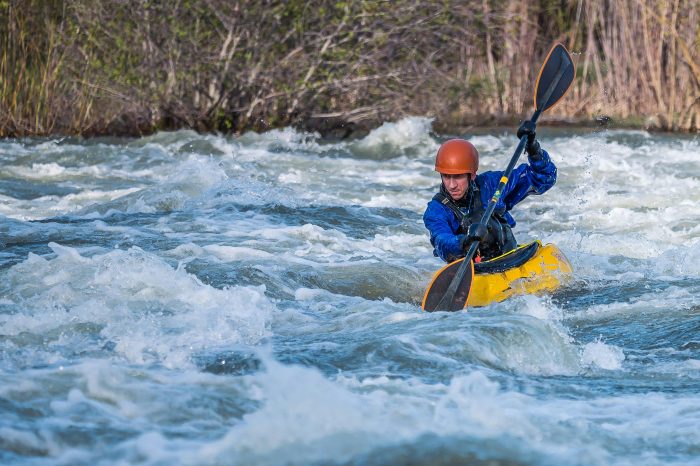
The kayak roll, often called the Eskimo roll, is one of the most valuable skills a sea or whitewater paddler can learn, and also one of the most intimidating to attempt for the first time. Done well, it turns a capsize from an emergency into a non-event. Done poorly, or relied upon without proper practice, it can create a dangerous false sense of security.
This guide covers how to actually learn to roll, the most common sticking points beginners encounter, the genuine debate around technique, and the honest limitations of relying on a roll as a safety skill.
Is a Roll Right for Your Kayak?
The kayak roll is specifically a sit-inside kayak skill. A roll relies on the paddler being connected to the kayak through the cockpit and using hip and knee contact with the hull to right the kayak after a capsize. Sit-on-top kayaks do not offer this connection, so rolling is not applicable to them. Sit-on-top paddlers who capsize simply climb back on rather than rolling.
If you paddle a sit-inside touring, sea, or whitewater kayak, a roll is a genuinely valuable skill. If you paddle a sit-on-top, this skill does not apply to your boat, and your self-rescue technique should focus on re-entry methods instead.
Read: How to Get In and Out of a Kayak
Start in a Pool or Calm, Warm Water
Nearly every experienced paddler who has learned to roll recommends starting in a controlled environment rather than attempting it for the first time in open water or rough conditions. A swimming pool is ideal, since the water is warm, calm, and shallow enough to stand up in if something goes wrong.
If a pool is not available, a calm, warm section of a lake with a gradually sloping sandy entry works as an alternative. Some paddlers use this exact approach: starting in shallow water close to shore and gradually moving into deeper water as confidence builds, pushing off the bottom to recover if a roll attempt fails, and only progressing to fully deep water once the failure rate drops significantly.
The Main Roll Techniques
There is genuine and ongoing debate among experienced paddlers about which roll technique is easier to learn, and the honest answer is that it depends on the individual.
The C-to-C Roll
The C-to-C roll involves a distinct two-part hip snap motion, moving the body into a C shape on one side of the kayak, then snapping through to a C shape on the other side as the kayak rights itself. Some paddlers find the separated, deliberate nature of the two movements easier to learn initially.
The Sweep Roll
The sweep roll uses a continuous sweeping paddle motion across the surface of the water combined with a more fluid hip snap, rather than the more abrupt two-part motion of the C-to-C. Many paddlers find this version more intuitive once the basic mechanics are understood, and several experienced paddlers in the kayaking community specifically recommend starting with the sweep roll over the C-to-C.
The Greenland Layback Roll
Several experienced paddlers identify the Greenland layback roll, often performed with an unfeathered Greenland-style paddle, as the easiest version to learn first. The technique and paddle shape work together in a way some paddlers find more forgiving than learning with a standard feathered paddle.
There is no single correct technique to start with. Trying a few approaches, ideally with an instructor who can assess which style suits your particular kayak fit and body mechanics, is more useful than committing to one method based on general advice alone.
The Most Common Beginner Mistakes
Lifting the head first – The single most repeated piece of advice from experienced paddlers is to keep the head down throughout the roll and let it come out of the water last, not first. The natural instinct when upside down underwater is to lift the head to breathe as early as possible, but doing so disrupts the hip snap and is one of the most common reasons a roll fails. The head should follow the rest of the body up, not lead it.
Relying on arm strength instead of hip snap – A roll is generated by hip and knee rotation against the kayak, not by pulling hard on the paddle with the arms. Paddlers who try to muscle the kayak upright with their arms generally struggle far more than those who focus on the hip snap and let the paddle provide support and leverage rather than the primary force.
Fighting the fear of being upside down – For many paddlers, the hardest part of learning to roll is not the physical technique but pushing through the psychological discomfort of being upside down underwater and trusting the process rather than panicking and bailing out. This genuinely takes time and repeated, controlled exposure to overcome, and is a completely normal part of the learning process rather than a sign of doing something wrong.
A Cautionary Tale: Ensure Spray Skirt Pull Tab is Reachable
Always check that the spray skirt’s pull tab is positioned outside the cockpit and easily reachable before launching, every single time, regardless of your experience level. If the spray skirt’s pull tab is accidentally tucked inside the cockpit rather than left hanging outside and accessible, you may be upside down and unable to find the pull tab. To prevent panic and struggle, make sure you can reach the pull tab easily.
A new or stiff spray skirt can also be harder to release than a well-worn one, which is worth being aware of when using new gear for the first time.
Practising Recovery Before the Full Roll
Several experienced paddlers recommend breaking the roll down into separate components rather than attempting the full motion immediately. A practical approach used by self-taught paddlers involves starting with a paddle float attached to one blade, which provides extra support, and focusing entirely on practising the recovery and hip snap motion rather than the capsize and roll together. Once the recovery motion feels natural with the float for support, the float can be removed and the full roll attempted.
Read: Best Inflatable Kayaks Under USD$500 for paddlers exploring different kayak types, or speak with your local paddling shop about paddle float options suited to rolling practice.
When a Roll Isn’t Available or Hasn’t Worked Yet
A roll is not the only way to recover from a capsize, and it should not be the only technique a paddler relies on. Particularly while still learning, or in any situation where a roll attempt fails, the standard wet exit remains the reliable fallback method available to every paddler in a sit-inside kayak.
Read: Can You Get Stuck in a Kayak if It Flips Over? How to Stay Safe
A confident roll and a well-practised wet exit work together, not as competing skills. Many experienced paddlers maintain both, using the roll when conditions and confidence allow, and falling back to a wet exit without hesitation whenever needed.
The Honest Limitation: Pool Skills Are Not the Same as Real Conditions
This is the single most important point in any discussion of kayak rolling, and one that experienced paddlers raise consistently. A roll learned and practised only in a calm pool or flat water is a genuinely different skill from a roll that works reliably in rough water, current, waves, or with a fully loaded touring kayak.
Experienced paddlers describe exactly this gap: rolling confidently in a pool, then finding it considerably harder, or initially impossible, in real whitewater or open water conditions. A roll that has never been tested in anything beyond calm water should not be relied upon as a safety net in genuinely challenging conditions.
This matters because a roll that fails in rough water, when the paddler is already cold, tired, or disoriented, can create exactly the dangerous situation the skill was meant to prevent. A failed roll attempt in difficult conditions, without the composure or energy to try again, has contributed to real incidents on the water. Treating an unproven roll as a guarantee of safety, rather than one tool among several, is a genuine risk.
The practical takeaway is to progressively test a roll in increasingly challenging, but still manageable and supervised, conditions once it is reliable in calm water, rather than assuming a pool-learned roll will work when it matters most. A backup plan, including a reliable self-rescue technique that does not depend on rolling, remains essential regardless of how confident the roll becomes.
Read: How to Keep Your Paddle Attached to Your Kayak for self-rescue planning that complements rolling skills.
Age, Injury, and Rolling
Rolling places real physical demands on the shoulders, hips, and core, and is not necessarily a skill every paddler needs or wants to maintain indefinitely. Some experienced older paddlers who learned to roll years ago choose to stop attempting it as shoulder issues or general physical changes make the movement less comfortable or higher risk, relying instead on calm-water paddling choices and reliable re-entry self-rescue methods.
This is a reasonable and sensible adaptation rather than a failure. Choosing not to roll, or to retire from rolling, and instead focusing on paddling conditions and self-rescue methods suited to current physical capability, is a valid approach at any stage of a paddling life.
Read: Kayaking for Seniors and Kayaking With Arthritis for related guidance on adapting paddling to changing physical capability.
Getting Started With an Instructor
While some paddlers successfully teach themselves to roll using online videos and practice, most experienced paddlers recommend at least some instruction from a qualified coach, particularly for the initial learning phase. An instructor can correct technique issues immediately, ensure the kayak fit is appropriate before starting, and provide the safety net of being able to assist if something goes wrong, such as becoming stuck in the cockpit or struggling with a spray skirt release.
Local paddling clubs and kayak shops frequently run pool-based rolling sessions or clinics, which provide both the controlled environment and the instructor support that make the learning process significantly safer and faster.
Frequently Asked Questions (FAQs)
Is the C-to-C roll or sweep roll easier to learn?
This varies between individuals. Some paddlers find the more distinct, two-part motion of the C-to-C roll easier to understand initially, while others find the continuous motion of the sweep roll more intuitive. Trying both with an instructor’s guidance is more useful than committing to one based on general advice.
Why do I keep failing my roll attempts?
The most common cause is lifting the head out of the water too early, which disrupts the hip snap that actually rights the kayak. Keeping the head down and letting it surface last, and focusing on hip and knee rotation rather than arm strength, resolves most early rolling difficulties.
Can I roll a sit-on-top kayak?
No. Rolling relies on the paddler being connected to the kayak through a cockpit with hip and knee contact, which sit-on-top kayaks do not provide. Sit-on-top paddlers use re-entry self-rescue methods instead of rolling.
Is a pool-learned roll enough for open water paddling?
Not necessarily. A roll that works reliably in a calm pool can fail in rough water, current, or with a loaded kayak, conditions that are considerably more demanding. Progressively testing a roll in increasingly challenging but supervised conditions, and maintaining a backup self-rescue plan, is important before relying on a roll as a genuine safety skill.
Do I need an instructor to learn to roll?
It is possible to self-teach using online videos and careful practice, but most experienced paddlers recommend at least some instruction, particularly early on. An instructor can correct technique issues quickly and provide a safety net during the learning process.
Is it normal to be afraid of rolling at first?
Yes. The psychological discomfort of being upside down underwater is one of the most commonly cited challenges among experienced paddlers learning to roll, regardless of physical ability. This typically improves with repeated, controlled practice rather than being something to push through in a single session.
Final Thoughts
Learning to roll a kayak is a genuinely valuable skill for sit-inside paddlers, but it takes patience, repetition, and an honest understanding of its limitations. Starting in a pool or calm water, focusing on hip snap rather than arm strength, keeping the head down until last, and progressively testing the roll in more challenging conditions all contribute to building a roll that is genuinely reliable rather than one that only works in ideal circumstances.
A roll is one part of a broader self-rescue toolkit, not a complete safety guarantee on its own. Pairing rolling practice with reliable backup self-rescue methods and realistic awareness of conditions remains essential regardless of how confident the roll becomes.
For more on kayaking safety and self-rescue, read our guides on is kayaking dangerous and how to keep your paddle attached to your kayak.