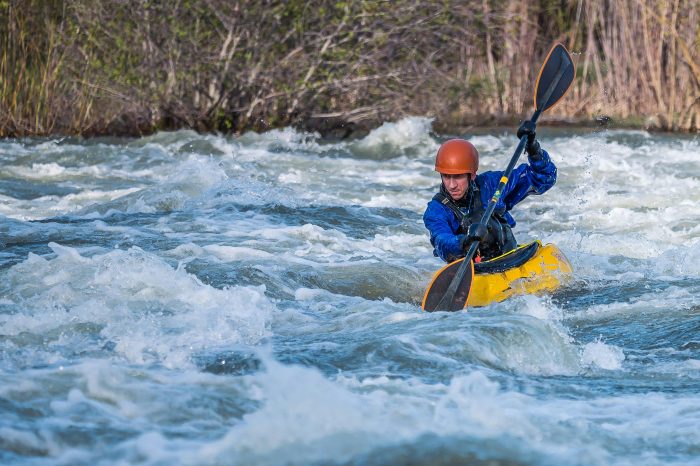
Wind is one of the most significant challenges recreational kayakers face on the water. A calm lake that felt easy to paddle on the way out can become a hard slog on the way back when the wind picks up. Understanding how wind affects your kayak and knowing how to respond makes a significant difference to your safety and enjoyment on the water.
This guide covers the effects of different wind directions on a kayak, practical paddling techniques for windy conditions, and when to stay off the water entirely.
How Wind Affects a Kayak
Understanding how wind interacts with your kayak is the foundation of paddling safely in windy conditions.
Headwind
A headwind blows directly into your face as you paddle forward. It slows your progress significantly and increases the effort required to cover distance. A strong headwind can make it impossible to make forward progress in a recreational kayak regardless of how hard you paddle.
Tailwind
A tailwind blows from behind, pushing you forward. It feels effortless and makes covering distance easy. The danger of a tailwind is that it can carry you further from shore faster than you realise, making the return paddle against the wind much harder than the outward journey.
Crosswind
A crosswind blows from the side. It pushes the kayak sideways and causes the bow to turn downwind, a phenomenon called weathercocking. Maintaining a straight course in a strong crosswind requires constant correction strokes that add fatigue over a longer session.
Wind and waves
Wind generates waves on open water. Even moderate wind can create waves that affect stability, make paddling more physically demanding, and increase the risk of capsizing. Wind-generated waves on large lakes and coastal water can be significantly larger than they appear from shore.
Reading Wind Conditions Before You Launch
Check the forecast Always check the wind forecast before launching. Look for both wind speed and wind direction. Wind speed is typically measured in kilometres per hour, miles per hour, or knots. As a general guide for recreational kayakers:
- Under 15 km/h (9 mph / 8 knots) — comfortable for most recreational paddlers
- 15 to 25 km/h (9 to 15 mph / 8 to 13 knots) — manageable for experienced recreational paddlers, challenging for beginners
- 25 to 35 km/h (15 to 22 mph / 13 to 19 knots) — challenging for most recreational paddlers, avoid open water
- Over 35 km/h (22 mph / 19 knots) — dangerous for recreational kayakers, stay off open water
Observe the water surface – The surface of the water gives a reliable indication of wind conditions. A glassy surface indicates little wind. Small ripples indicate light wind. Whitecaps on the surface of a lake or bay indicate wind strong enough to make recreational paddling challenging and potentially dangerous.
Watch for gusts – Forecast wind speeds are averages. Gusts can be significantly stronger than the average speed and can arrive suddenly. Dark patches moving across the water surface indicate gusts approaching. Allow for gusts when assessing whether conditions are suitable.
Consider the direction relative to your route – Wind direction matters as much as wind speed for planning a paddle. A wind blowing parallel to your route is easier to manage than one blowing directly onto an exposed shore you need to reach. Always plan your route so that the most challenging section is completed first while you are fresh rather than at the end of a paddle when you are fatigued.
Paddling Techniques for Windy Conditions
Paddle into the wind first – Always plan your paddle so that you head into the wind at the start of the session and have the wind at your back for the return. Paddling into a headwind when you are fresh is significantly easier than fighting your way back against the wind when you are tired. A tailwind on the return also provides a safety margin if conditions deteriorate.
Lower your paddling angle – In strong wind, lower your paddle shaft angle so the blades are closer to horizontal. A lower paddle angle reduces the surface area exposed to the wind between strokes, which prevents the wind from catching the blade and disrupting your stroke.
Shorten your stroke – A shorter, quicker stroke is more efficient in headwind conditions than a long, powerful stroke. Long strokes in a headwind allow more time for the wind to slow your forward momentum between strokes. Short, frequent strokes maintain more consistent forward speed.
Use a low brace – In crosswind conditions with wave action, a low brace on the downwind side provides stability if a wave catches you off balance. Place the back face of the paddle blade flat on the water surface beside the kayak and push down gently to stabilise.
Edge into the wind – In a strong crosswind, edging the kayak slightly toward the wind by lifting the downwind knee helps counteract the weathercocking effect. This keeps the bow tracking straighter without requiring constant correction strokes. Practise edging on calm water before attempting it in windy conditions.
Use the sweep stroke for correction – When a crosswind pushes the bow downwind, a sweep stroke on the downwind side brings the bow back on course. A forward sweep on the downwind side combined with a reverse sweep on the upwind side provides strong directional correction without losing significant forward momentum.
Rudder and skeg use – If your kayak has a rudder or skeg, deploy it in crosswind and headwind conditions to reduce the effort required to maintain a straight course. A skeg deployed partially reduces weathercocking in a crosswind without making the kayak unresponsive. A rudder provides active directional control.
Read: Skeg vs Rudder: Which Does Your Kayak Need?
Paddle close to shore – In windy conditions, paddle close to the shoreline where wind is often reduced by the shelter of the land. Staying close to shore also means you are never far from a landing point if conditions deteriorate rapidly.
Rest in sheltered areas – Use headlands, bays, islands, and reed beds as sheltered rest points during a windy paddle. Resting in a sheltered area allows you to recover before tackling the next exposed section.
Weathercocking: What It Is and How to Deal With It
Weathercocking is the tendency of a kayak to turn its bow into the wind when paddling in crosswind conditions. It happens because the wind catches the exposed stern of the kayak more than the bow, pushing the stern downwind and the bow upwind.
Weathercocking is more pronounced in some kayaks than others. Sea kayaks with a pronounced rocker profile weathercock more than flat-bottomed recreational kayaks. A skeg deployed partially reduces weathercocking significantly by increasing resistance at the stern.
If your kayak weathercocks strongly in a crosswind without a skeg, try edging the kayak slightly toward the wind which reduces the stern’s exposure. If the weathercocking is severe enough to make paddling exhausting, head for shore and wait for conditions to improve rather than fighting the kayak for the entire paddle.
Wind Safety on Different Water Types
Inland lakes – Wind on inland lakes can generate surprisingly large waves particularly on larger bodies of water. Open lake crossings are significantly more exposed than paddling along the shoreline. Avoid crossing large open bodies of water in windy conditions and stick to the sheltered shoreline instead.
Rivers – Wind on rivers is generally less significant than on open water as the banks provide shelter. However, strong wind on wide rivers and tidal estuaries can create challenging conditions. Wind direction relative to the river channel affects conditions significantly.
Coastal water – Coastal water is the most exposed environment for wind. Offshore winds blow from land to sea and can carry an unwary paddler rapidly away from shore into open water. Onshore winds blow from sea to land and create surf and wave conditions at the shoreline. Side shore winds create crosswind conditions across the paddling route. Always check wind direction relative to the coast before launching.
Read: Is Kayaking Dangerous?
When To Stay Off the Water
There are conditions where the safest decision is not to launch:
- Wind speed above 25 km/h (15 mph) for beginners on open water
- Wind speed above 35 km/h (22 mph) for all recreational paddlers on open water
- Whitecaps visible on the water surface
- Forecast predicts strengthening wind during your planned paddle time
- You are paddling alone in a location with no shelter
- The wind is offshore and could carry you away from shore
A good rule is that if you are uncertain whether conditions are suitable, they probably are not. It is always better to postpone a paddle than to find yourself in conditions beyond your ability to manage safely.
Gear That Helps in Windy Conditions
Low-profile kayak – A lower-profile kayak with less freeboard presents less surface area to the wind and is easier to control in windy conditions than a high-sided kayak. Sit-inside sea kayaks are generally better suited to windy conditions than high-sided sit-on-top recreational kayaks for this reason.
Rudder or skeg – A kayak with a rudder or skeg is significantly easier to control in crosswind conditions. If you paddle in exposed locations regularly, a kayak with directional control is worth the additional cost.
Low-angle paddle – A lower-angle paddle with narrower blades presents less surface area to the wind during the recovery phase of the stroke. High-angle paddles with wide blades catch more wind and become tiring to use in strong crosswinds.
Spray skirt – In sit-inside kayaks, a spray skirt keeps water out of the cockpit in waves and spray generated by wind. For touring in exposed conditions, a spray skirt is an important piece of safety equipment.
Read: Best Kayak Spray Skirts
Secure all gear – In windy conditions, anything not secured to the kayak can be blown overboard instantly. Secure all loose items in hatches or under bungee cords before launching in windy conditions. Attach your paddle to the kayak with a paddle leash so it cannot be blown away if you capsize.
Frequently Asked Questions (FAQs)
How much wind is too much for kayaking?
For beginner recreational kayakers on open water, wind above 15 km/h (9 mph) starts to become challenging. Wind above 25 km/h (15 mph) is too much for most beginners on open water. Experienced paddlers can manage stronger conditions but wind above 35 km/h (22 mph) is dangerous for recreational kayakers regardless of experience level.
Why does my kayak keep turning in the wind?
Weathercocking is the tendency of a kayak to turn its bow into the wind in crosswind conditions. It is caused by the wind pushing the stern downwind. Deploying a skeg partially, edging the kayak slightly toward the wind, and using correction strokes on the downwind side all help reduce weathercocking.
Is it easier to kayak with or against the wind?
Paddling with a tailwind is significantly easier than paddling into a headwind. Always plan your paddle so that you head into the wind first and have the tailwind on the return journey. This ensures the hardest part of the paddle is completed when you are fresh and provides a safety margin if conditions strengthen.
Can wind flip a kayak?
Wind alone rarely flips a kayak directly but wind-generated waves can. In strong wind on open water, waves large enough to destabilise or capsize a recreational kayak can develop quickly. Whitecaps on the water surface are a reliable indicator that conditions are becoming unsafe for recreational kayaking.
How do I stop my kayak from being blown sideways?
A crosswind pushes the kayak sideways through the water. Paddling close to shore provides shelter. Deploying a skeg reduces the lateral drift. Edging the kayak slightly toward the wind and using correction strokes on the downwind side help maintain your intended course.
Should I use a rudder in windy conditions?
A rudder is very useful in windy conditions as it provides active directional control without requiring correction strokes that interrupt your paddling rhythm. If your kayak has a rudder, deploy it in crosswind and headwind conditions to reduce effort and maintain a straighter course.
Final Thoughts
Wind is one of the most common challenges recreational kayakers face and one of the most manageable with the right knowledge and approach. The most important habits are checking the forecast before every paddle, planning your route so the wind is at your back on the return, staying close to shore in exposed conditions, and knowing when conditions are beyond your ability to manage safely.
Start building experience with wind on sheltered water in light conditions before venturing onto more exposed locations in stronger wind. Confidence and technique in windy conditions develop with practice and make every paddle safer and more enjoyable.
For more on kayaking safety and technique, read our guides on is kayaking dangerous and why is your kayak unstable.