Whether to leash a dog on a kayak or paddleboard is one of the most genuinely debated questions in the dog paddling community, and the honest answer is that it depends on the specific situation rather than a single universal rule. Experienced paddlers are divided, and both positions have genuine merit depending on the water, the dog, and the circumstances.
This guide covers the real arguments on both sides, the situations where a leash makes sense and where it creates more risk than it prevents, and the one thing that experienced dog paddlers consistently agree on regardless of their leash position.
The Case Against Leashing on the Water
The majority of experienced dog paddlers in active paddling communities advise against leashing a dog while on the water, and the reasons are specific and serious rather than casual preference.
Entanglement risk
A leash in water creates genuine entanglement risk for both the dog and the paddler. In a capsize, the situation becomes chaotic and unpredictable — a leash can wrap around a dog’s legs, catch on underwater obstacles, or tangle with the paddler’s own body or the kayak in ways that are very difficult to manage when already in the water. This risk is significantly higher in moving water, current, or any conditions with underwater hazards.
A leash can prevent a dog from reaching safety
If a paddler capsizes and is incapacitated, a dog leashed to the paddler or the kayak may be unable to swim to shore or reach safety independently. In a worst-case scenario, a leashed dog can be pulled under by a sinking or moving boat.
Real incidents have occurred
At least one documented incident in paddling communities involved a dog and its owner drowning when a leash became entangled and neither could free themselves. This is not a theoretical risk — it is a specific failure mode that experienced paddlers have seen firsthand.
Moving water specifically
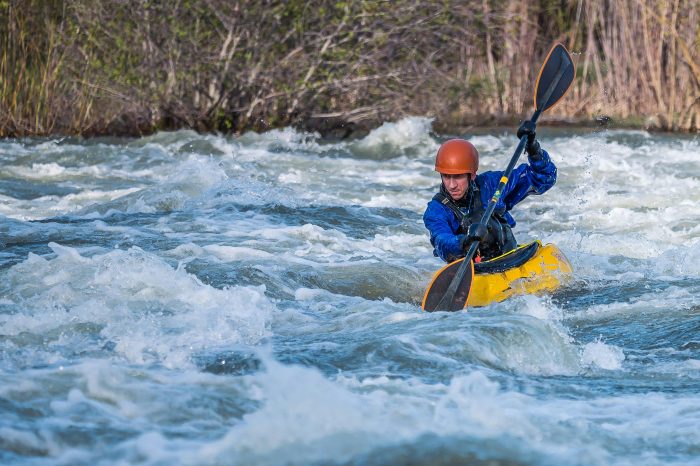
In any water with current — rivers, tidal flows, rapids — a leash is almost universally considered dangerous by experienced paddlers. The force of moving water combined with an entangled leash can overpower both dog and paddler.
The Case For Leashing in Specific Situations
Despite the risks above, some experienced paddlers do use leashes in specific, controlled circumstances, and their reasoning is also worth understanding.
Keeping a small or anxious dog close
For very small dogs, particularly those that might be targeted by birds of prey, or for anxious dogs that might jump unexpectedly, a short leash can provide a meaningful safety margin that experienced paddlers find outweighs the entanglement risk in calm conditions.
Attaching leash to PFD handle rather than boat or board
Several experienced paddlers specifically recommend attaching a leash to the dog’s PFD handle and the paddler’s own PFD rather than to the kayak or board. This keeps the dog close to the paddler rather than attached to a potentially sinking or drifting vessel, and allows both to move together in the water rather than being pulled in different directions.
Calm, flat water with clear visibility
In genuinely calm, flat, shallow water with no current and clear visibility of the bottom, a short leash presents less entanglement risk than in open or moving water. Some paddlers use a leash only in these specific conditions and remove it in anything more challenging.
Never attach a leash to an inflatable board
One specific and widely shared caution: never attach a dog’s leash directly to an inflatable paddleboard. If the board deflates or flips, the dog can be pulled under with it. Any leash connection should be between the dog’s PFD and the paddler’s body or PFD, not the watercraft itself.
The Drag Line: A Middle Ground Option
A drag line is a leash without a handle — typically a length of cord attached to the dog’s collar or harness that trails behind them in the water. The absence of a handle reduces the risk of the line snagging on obstacles, and it provides something to grab if needed without fully tethering the dog.
Some experienced paddlers use a drag line as a compromise between full leash and no leash, particularly for dogs still learning to paddle and return reliably to the kayak on command. The drag line allows intervention if needed while reducing the most serious entanglement risks associated with a standard leash.
The One Thing Everyone Agrees On: Voice Control and Training
Regardless of leash preference, experienced dog paddlers consistently identify strong obedience training and reliable voice recall as the most important safety tool available — more important than any leash decision.
A dog with reliable recall and a solid “stay” command is safer on the water than a poorly trained dog with a leash, because the leash creates its own risks while obedience training reduces the need for physical restraint entirely.
Key commands worth developing before taking a dog on the water:
- Recall — a reliable, immediate return to the paddler on command, even from the water
- Stay — remaining on the kayak or board without jumping off until released
- Release word — a specific word that signals permission to enter the water, so the dog doesn’t jump in uninvited
- On command — loading onto the kayak or board on instruction
These commands take time to develop but make the difference between a dog that needs constant physical management and one that is genuinely safe company on the water.
A Practical Guide
One of the most sensible and widely shared approaches among experienced dog paddlers breaks the decision down by water type:
- Calm, flat lakes and reservoirs = no leash, with reliable recall and a PFD on the dog
- Open water, bays, or ocean = leash from the paddler’s PFD to the dog’s PFD handle, keeping both together rather than attaching to the vessel
- Moving water, rivers, or white water = no dog
This framework is not a universal rule, but it provides a sensible starting point for thinking about the decision situationally rather than with a blanket yes or no.
Before the First Paddle: Building Water Confidence
For dogs new to kayaking or paddleboarding, the process of building confidence in and around water before the first real paddle session significantly reduces the risk of unexpected behaviour on the water.
Introduce the kayak on land first
Allow the dog to sniff, investigate, and sit in the kayak while it is stationary on land. Reward calm behaviour generously. This builds familiarity before adding the complexity of water.
Introduce swimming with the PFD on
Practice swimming sessions in shallow, calm water with the PFD on before any paddling. This builds familiarity with the PFD’s buoyancy and movement, and confirms the dog can swim comfortably in it.
Practise re-entry
One of the most valuable skills for a paddling dog is knowing how to get back onto the kayak or paddleboard independently if they fall in. Practise this specifically in shallow water before paddling in deeper conditions, using something grippy on the deck to help the dog find purchase when climbing back on.
Equipment Worth Having
A PFD with a sturdy handle – A well-fitted dog PFD with a sturdy handle on the back is considered essential by virtually every experienced dog paddler. The handle provides a reliable way to lift the dog back aboard, particularly useful when the dog is wet and heavier than usual.
Read: Best Dog Life Jackets for Kayaking and Paddleboarding
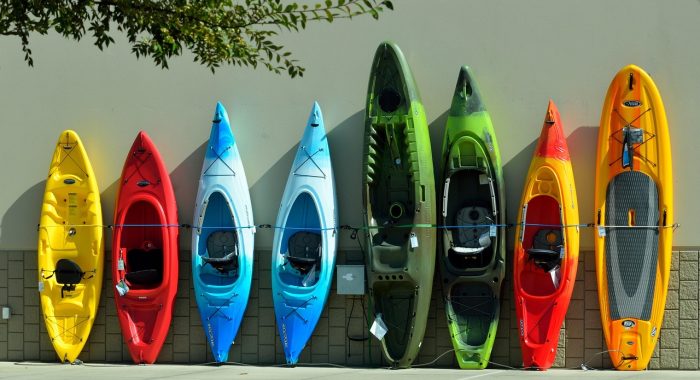
A stable, wide kayak or paddleboard – A wider, more stable platform reduces the likelihood of a capsize caused by a dog moving unexpectedly, and provides more space for the dog to settle comfortably during the paddle.
Read: Best Inflatable Kayaks for Dogs
Fresh water for your dog – Dogs can dehydrate quickly on the water, particularly on warm days. Carry fresh water and a portable bowl, and offer it regularly during and after the paddle.
Frequently Asked Questions (FAQs)
Should I leash my dog on a kayak?
It depends on the water conditions, the dog, and how the leash is attached. In moving water or open water with hazards, most experienced paddlers advise against leashing due to entanglement risk. In calm, flat conditions, a short leash from the dog’s PFD to the paddler’s own PFD can be reasonable. Voice recall and obedience training are more universally agreed upon as the primary safety tool.
What is a drag line for dogs on kayaks?
A drag line is a leash without a handle that trails behind the dog in the water. It provides something to grab if needed while reducing the snag and entanglement risk of a standard leash with a handle. It is a middle-ground option used by some paddlers with dogs still developing their water recall.
Can a leash be dangerous for a dog on a kayak?
Yes, in specific circumstances. In moving water or a capsize situation, a leash can become entangled around a dog’s legs, catch on underwater obstacles, or attach the dog to a sinking vessel. At least one documented incident has involved a dog and owner drowning due to leash entanglement. This risk is highest in moving water and capsize situations.
What commands does a dog need before kayaking?
A reliable recall, a solid stay command, a release word for entering the water, and an on-board command are the most important. These take time to develop but are more important than any leash decision for genuinely safe paddling with a dog.
Should I attach my dog’s leash to the kayak or to myself?
If using a leash, attach it to your own PFD rather than to the kayak or paddleboard. This keeps the dog connected to you rather than to a potentially sinking or drifting vessel, and is the approach recommended by experienced paddlers who do use leashes on the water.
At what age can a dog start kayaking?
Most experienced dog paddlers suggest waiting until a dog is at least one year old and has developed basic obedience skills before introducing kayaking. Puppies are unpredictable, less responsive to commands, and more prone to sudden movements that can destabilise a kayak.
Final Thoughts
The leash question doesn’t have a single right answer — it has a situational one. Moving water and open water with hazards call for no leash and strong obedience training. Calm, flat water may accommodate a short leash attached to the paddler’s PFD rather than the vessel. The drag line offers a middle ground for dogs still developing reliable recall.
What every experienced dog paddler agrees on, regardless of leash preference, is that a well-fitted PFD with a sturdy handle and genuine obedience training are the two most important investments for safe paddling with a dog.
For more on paddling with dogs, read our guides on best dog life jackets for kayaking and paddle boards vs kayaks for dogs.