Choosing the right kayak paddle length makes a significant difference to comfort, efficiency, and fatigue on the water. A paddle that is too long forces a wide sweeping stroke that wastes energy. A paddle that is too short causes you to hunch over and catch the sides of the kayak with each stroke.
The right paddle length is determined by three factors: your height, the width of your kayak, and your preferred paddling style.
Why Paddle Size Matters
An incorrectly sized paddle creates problems that become more noticeable over longer sessions:
- A paddle that is too long encourages a low, sweeping stroke that is less efficient and harder to control
- A paddle that is too short causes you to lean forward and hunch over to reach the water, leading to back and shoulder strain
- The wrong length makes it harder to maintain straight-line tracking
- Carrying extra length adds unnecessary weight that contributes to fatigue over time
Getting the right paddle length from the start develops better technique and makes kayaking more enjoyable from the first session.
Key Factors in Paddle Sizing
1. Your Height and Torso Length
Your overall height and torso length are the primary determinants of paddle length. Taller paddlers need longer paddles. Most sizing charts use overall height as the starting point, but torso length is a more precise measurement for fine-tuning the recommendation.
Torso length is measured in a seated position from the seat surface to the tip of your nose. This tells you how high your hands sit above the kayak sides, which directly affects how long the paddle needs to be.
| Torso Height | High Angle (cm) | Low Angle (cm) |
|---|---|---|
| 61cm to 71cm (24″ to 28″) | 210 to 215 cm | 215 to 220 cm |
| 71cm to 76cm (28″ to 30″) | 220 to 230 cm | 230 cm |
| Over 76cm (30″) | 230 cm | 230 cm |
2. Kayak Width
The wider your kayak, the longer the paddle needs to be to reach the water comfortably without clipping the sides. Fishing kayaks and recreational sit-on-tops tend to be wider and generally need longer paddles than narrower touring or sea kayaks.
| Kayak Type | Length | Width |
|---|---|---|
| Recreational | 1.8m to 3.7m (6ft to 12ft) | 66cm to 76cm (26″ to 30″) |
| Touring | 3.7m to 4.6m (12ft to 15ft) | 56cm to 63cm (22″ to 25″) |
| Whitewater | 2.4m to 3.7m (8ft to 12ft) | Width is less critical |
| Performance | 4.6m to 5.5m (15ft to 18ft) | 48cm to 56cm (19″ to 22″) |
3. Paddling Style
Your preferred stroke angle affects the ideal paddle length.
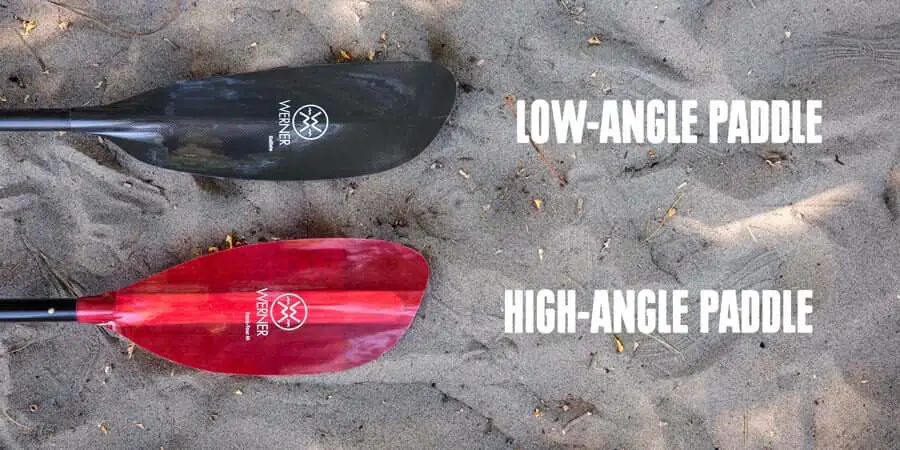
Low-angle paddling uses a more horizontal stroke where the paddle shaft stays relatively flat. This is the most common recreational paddling style and suits touring, fishing, and casual paddling. Low-angle paddlers generally use longer paddles with narrower, longer blades.
High-angle paddling uses a more vertical stroke where the blade enters the water closer to the kayak. This style generates more power per stroke and suits sea kayaking and more aggressive paddling. High-angle paddlers use shorter paddles with wider, shorter blades.
How To Find the Right Paddle Length
Method 1: Height and Kayak Width
The most reliable method combines your height with your kayak width using the sizing charts below.
Low-angle paddle size guide:
| Paddler Height | Under 61cm (24″) | 61cm to 71cm (24″-28″) | 74cm to 84cm (29″-33″) | Over 84cm (33″) |
|---|---|---|---|---|
| Under 152cm (5ft) | 210 cm | 220 cm | 230 cm | 240 cm |
| 152cm to 168cm (5ft to 5’6″) | 215 cm | 220 cm | 230 cm | 240 cm |
| 168cm to 183cm (5’6″ to 6ft) | 220 cm | 220 cm | 230 cm | 250 cm |
| Over 183cm (6ft) | 220 cm | 230 cm | 250 cm | 250 cm |
High-angle paddle size guide:
| Paddler Height | 43cm to 58cm (17″-23″) | 58cm to 63cm (23″-25″) | Over 63cm (25″) |
|---|---|---|---|
| Under 152cm (5ft) | 200 cm | 210 cm | 220 cm |
| 152cm to 168cm (5ft to 5’6″) | 210 cm | 220 cm | 230 cm |
| 168cm to 188cm (5’6″ to 6’2″) | 220 cm | 230 cm | 240 cm |
| Over 190cm (6’3″) | 230 cm | 240 cm | 250 cm |
Whitewater paddle size guide:
| Paddler Height | Paddle Length |
|---|---|
| Under 158cm (5’2″) | 188 to 194 cm |
| 158cm to 173cm (5’2″ to 5’8″) | 190 to 196 cm |
| 173cm to 185cm (5’8″ to 6’1″) | 192 to 200 cm |
| Over 185cm (6’1″) | 196 to 204 cm |
Method 2: The Reach Test
Stand the paddle upright next to you. Reach your arm straight up and curl your fingers over the top blade. If you can hook your fingers comfortably over the edge, the length is approximately right. If you cannot reach the blade at all, the paddle is too long. If your whole hand extends well above the blade, the paddle may be too short.
Note that this method does not account for kayak width or paddling style, so use it as a rough check rather than a definitive guide.
Paddle lengths in cm and inches:
| Paddle Length (cm) | Paddle Length (inches) |
|---|---|
| 190 | 74.8 |
| 200 | 78.7 |
| 210 | 82.7 |
| 220 | 86.6 |
| 230 | 90.5 |
| 240 | 94.5 |
| 250 | 98.4 |
Final Thoughts
For most recreational paddlers using a standard width kayak, a 220cm to 230cm paddle is a good starting point. Adjust up if you are tall or paddling a wide kayak, and adjust down if you are shorter or using a narrow touring kayak.
If possible, try a few different lengths before buying. Most kayak hire and touring companies have a range of paddle sizes available, and testing different lengths in real conditions is the most reliable way to find your ideal fit.
For more on kayaking equipment, read our guides on why kayak paddles are so expensive and how to choose a kayak.