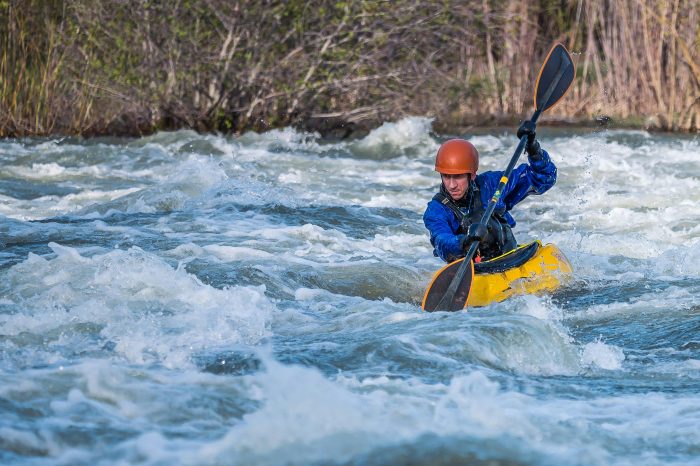
Kayaking burns a meaningful number of calories and provides a solid full-body workout, but the exact amount depends on your body weight, paddling intensity, and the conditions you paddle in.
As a general guide, recreational kayaking burns around 280 to 400 calories (1,170 to 1,675 kilojoules) per hour for most adults. More intense paddling on moving water or with greater effort can burn significantly more.
How Many Calories Does Kayaking Burn?
Calorie burn during kayaking is primarily determined by body weight and paddling intensity. Heavier paddlers and those paddling harder burn more calories per hour.
Here is a general guide based on body weight at moderate recreational paddling intensity:
| Body Weight | Calories per hour | Kilojoules per hour |
|---|---|---|
| 57kg (125lbs) | 280 cal | 1,170 kJ |
| 70kg (155lbs) | 340 cal | 1,420 kJ |
| 84kg (185lbs) | 400 cal | 1,675 kJ |
| 91kg (200lbs) | 455 cal | 1,905 kJ |
These figures are approximate and based on moderate recreational paddling on flat water. Paddling harder, in current, or against wind will increase calorie burn significantly. A full day of touring paddling can burn 1,500 to 2,000 calories (6,280 to 8,370 kilojoules) or more.
Is Kayaking Good Exercise?
Kayaking is a genuinely effective form of exercise that works multiple muscle groups simultaneously. The forward paddling stroke engages the core, back, shoulders, arms, and chest. Bracing and balance work the core and lower body. Over a full session, kayaking provides both aerobic exercise and muscular endurance training.
Compared to other outdoor activities, kayaking burns a similar number of calories to cycling at moderate intensity and more than walking at the same duration.
The main advantage of kayaking as exercise is that it does not feel like a traditional workout. Time on the water passes quickly, which makes it easier to sustain than gym-based exercise for many people.
Read: What Muscles Does Kayaking Work?
Tips To Burn More Calories While Kayaking
Engage your core
Active core engagement during the forward stroke increases the work done by your abdominal and back muscles. Focus on rotating your torso with each stroke rather than pulling with your arms alone. This improves paddling efficiency and increases overall calorie burn.
Paddle in more challenging conditions
Moving water, wind, and chop require more effort to paddle through than flat calm water. As your technique and fitness improve, progressively more challenging conditions increase the intensity of the workout.
Paddle for longer
Increasing session length is the simplest way to burn more total calories. Start with sessions of 45 to 60 minutes and build up gradually. Aim for two to three sessions per week for consistent fitness benefits.
Paddle with others
Paddling with a group or club increases motivation and makes longer sessions more enjoyable. Having others to paddle with makes it easier to commit to regular sessions.
Combine kayaking with a healthy diet
Exercise alone rarely produces significant weight loss without attention to diet. Kayaking works best as part of a broader approach that includes regular exercise and a balanced diet.
Consider an inflatable kayak for convenience
If transporting and storing a hardshell kayak is a barrier to paddling regularly, an inflatable kayak removes that obstacle. Most inflatable kayaks pack into a bag and can be stored in a cupboard or car boot.
Read: Best Inflatable Kayaks Under USD$500
Final Thoughts
Kayaking burns around 280 to 455 calories (1,170 to 1,905 kilojoules) per hour at moderate intensity, making it a practical and enjoyable form of exercise for people of all fitness levels. The combination of aerobic exercise, muscular endurance, and time outdoors makes it one of the more sustainable exercise options available.
For more on the health benefits of paddling, read our guide on what muscles does kayaking work.