Sawhorses are one of the most practical and affordable solutions for storing a kayak at home. They are inexpensive, easy to set up, and work well for both short-term and long-term storage.
Kayaks can be safely stored on sawhorses as long as the sawhorses are padded, the weight is distributed evenly, and the kayak is positioned correctly. This guide covers everything you need to know to store your kayak on sawhorses safely.

Are Sawhorses Sturdy Enough To Store Kayaks?
Most sawhorses are more than strong enough to support a kayak. Sawhorses are designed to provide stable support during demanding tasks like sawing and painting, and most quality pairs can hold several hundred kilograms without issue.
The material of the sawhorse affects its load capacity:
Wooden sawhorses are the most common choice for kayak storage. Their strength depends on the quality of the wood and construction, but most well-built wooden sawhorses handle a kayak without any trouble.
Metal sawhorses are the strongest option and can hold significant weight. Any heavy-duty metal sawhorse pair is more than adequate for kayak storage.
Plastic sawhorses are generally not recommended for kayak storage. Most plastic sawhorses are designed for lightweight tasks and may not provide reliable support for the sustained weight of a kayak over time.
How To Store a Kayak on Sawhorses
Using Two Sawhorses
The most common method is to balance the kayak on two sawhorses, one placed under each end of the hull. Position each sawhorse roughly one quarter of the kayak’s length from each end to distribute the weight evenly.
The kayak can be stored either right side up or upside down. Storing it upside down is generally the better option for long-term storage as the flat top surface provides a more stable resting point and takes pressure off the hull. If storing right side up, make sure each sawhorse rests at the flattest point of the hull to prevent rocking.
Pad the top of each sawhorse with carpet, foam pipe insulation, or pool noodles to protect the hull from pressure points and scratches.
Using Four Sawhorses
A second method uses four sawhorses rather than two, adding a second sawhorse alongside each of the original pair. This creates a wider support platform that reduces the risk of the kayak rolling off and distributes the weight more evenly across a larger contact area.
This approach works particularly well if the sawhorses are shorter or if you are storing a heavier kayak. Strap or tape each pair of sawhorses together to keep them stable.
Vertical or Horizontal: What Is the Best Way To Store a Kayak?
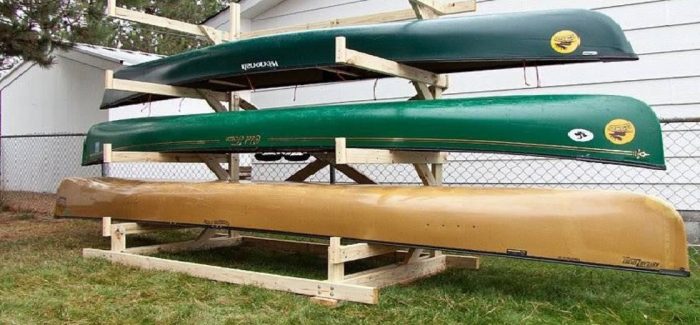
Horizontal storage is the better option for long-term kayak storage. Storing the kayak horizontally on padded sawhorses distributes the weight evenly across the hull and avoids creating pressure points that can cause warping over time. This is the recommended method for most kayakers.
Vertical storage places the full weight of the kayak on a single point of the hull, which can cause deformation over extended periods. Vertical storage is acceptable for very short periods of a day or two, but should not be used for long-term storage. If storing vertically, lean the kayak against a solid wall with padding between the hull and the wall.
Never store a kayak flat on the ground for more than a few days. Direct ground contact concentrates weight on the hull contact points and can cause warping, and moisture can accumulate underneath.
Alternatives to Sawhorses
If sawhorses are not practical for your space, there are several other storage options worth considering.
Wall mounts are a space-efficient option for garage storage. Padded wall brackets hold the kayak on its side against the wall, keeping it off the floor and out of the way.
Ceiling hoists use a pulley system to raise and lower the kayak from the ceiling. They free up floor and wall space entirely, making them ideal for small garages. Look for a system rated for at least 45kg (100lbs).
Read: How To Store a Kayak & Are Kayak Racks Really Necessary?
For wall mounts and ceiling hoists, the RAD Sportz Kayak Wall Hangers are a practical and affordable option available on amazon.com.au.
Final Thoughts
Sawhorses are a practical and affordable storage solution for most kayakers. Use padded wooden or metal sawhorses, position them evenly under the hull, and store the kayak horizontally for the best results. With the right setup, sawhorses will keep your kayak safe and in good condition between sessions.
For a full guide on kayak storage including indoor, outdoor, and wall mounting options, read our guide on how to store a kayak.